
As predicted, the Federal Treasurer, the Hon Dr Jim Chalmers MP, has delivered a pre-election budget. However, while we might have expected such circumstances could be ripe to canvas opportunities for tax reform, there were very few mentions of tax at all.
The Treasurer outlined the Government’s priorities as alleviating cost-of-living pressures, improving access to healthcare and housing, investing in education, and strengthening the economy – all appropriate and worthy recipients of attention and funding, especially in the current economic climate.
But the question that would be obvious to our clients is: how do we pay for it? The absence of any commitment to reforming a tax system that is in dire need of it is concerning. Where does the tax system fit into these plans?
While interest rates have recently been reduced by 25 basis points for the first time since 2020, and inflation has fallen to 2.5% – finally back within the Reserve Bank of Australia’s target of 2–3% – the impact on prices of higher inflation in recent years is still being felt by Australian families and businesses.
Measures targeted to relieve cost-of-living pressures, like the proposed new tax cuts, are in response to the continued challenging economic environment, which is forecast to continue into 2025–26. While this measure, if enacted, would represent slight relief for most taxpayers, it is not enough on its own to remedy pervasive bracket creep. Nor is it the answer to Australia’s long overreliance on personal income tax as one of its main sources of revenue.
While this Budget gives us an indication of some measures that may be pursued post-election, in reality they all hang in the balance until a new government is formed and its priorities are laid down. What is certain is that the uncertainty will remain for some time.
Our Budget summary is shorter than usual due to the few tax-related announcements in this Budget. It is intended to provide more than a summary of the measures: we have endeavoured to provide clarity and certainty where possible so that you are informed as to how this Budget affects you.


Personal income tax measures
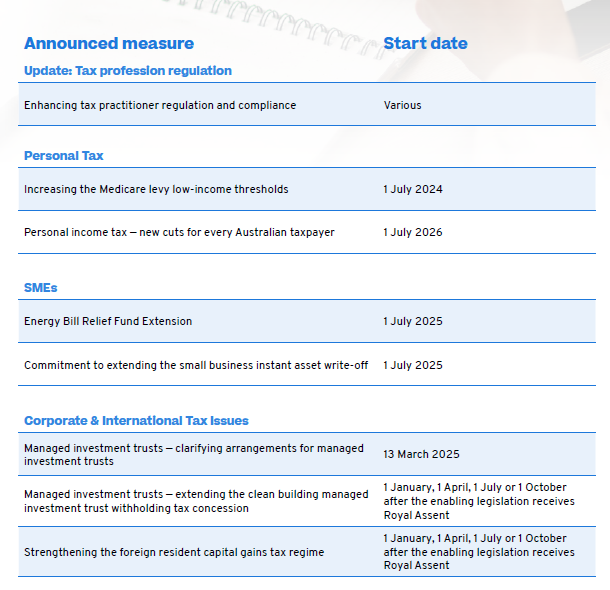
New tax cuts for individual taxpayers in 2027 and 2028
The Government will deliver new tax cuts to individual taxpayers commencing from 1 July 2026 (i.e. from the 2027 income year). Under the new tax cuts, it is proposed that:
- the (current) 16% tax rate will be reduced to 15% from 1 July 2026; and
- the 15% tax rate will be further reduced to 14% from 1 July 2027.
As there are limited parliamentary sitting days until the Federal election in May, it is unlikely that these proposed tax cuts will be legislated before the election. Given this practical reality, the measure will likely be contingent on the re-election of the Labor Government and securing passage of the enabling legislation through the new Parliament.
The personal income tax rates (excluding the Medicare levy) for the 2025 and 2026 income years are set out in the following table, along with the proposed changes to the tax rates for the 2027 and 2028 income years:
| Thresholds | 2025 and 2026 income years | 2027 income year | 2028 income year |
|---|---|---|---|
| $0 – $18,200 | Tax-free | Tax-free | Tax-free |
| $18,201 – $45,000 | 16% | 15% | 14% |
| $45,001 – $135,000 | 30% | 30% | 30% |
| $135,001 – $190,000 | 37% | 37% | 37% |
| $190,001+ | 45% | 45% | 45% |
By way of example, a taxpayer earning between $18,201 and $45,000 will get a tax cut of up to $268 in the 2027 income year and up to $536 from the 2028 income year.
It should also be noted that these tax cuts are not proposed to apply before 1 July 2026, meaning that, even if ultimately enacted, their impact in alleviating pressure on taxpayers will not be apparent for more than 12 months.
Increased Medicare levy low-income thresholds
The Government will increase the Medicare levy low-income threshold amounts and phase-in ranges for single individuals, families, and seniors and pensioners that apply from 1 July 2024 to provide cost-of-living relief, as set out in the table below.
The increase to the thresholds ensures that low-income individuals continue to be exempt from paying the Medicare levy or pay a reduced levy rate.
The Medicare levy low-income thresholds for the 2025 income year, together with the comparative thresholds for earlier income years, will be as follows:
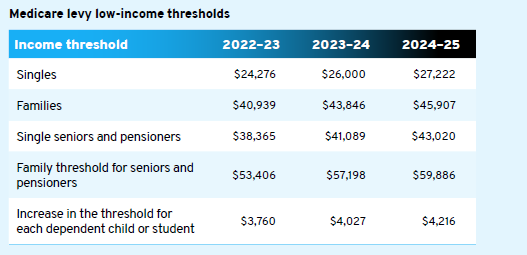
For each dependent child or student, the family income thresholds will increase by a further $4,216 (up from $4,027).
Tax issues for SMEs
Small business instant asset write-off
The Government has reconfirmed its commitment to deliver the previously announced measure to temporarily extend the $20,000 instant asset write-off (IAWO) threshold by 12 months to 30 June 2025. The measure was contained in Schedule 4 to the Treasury Laws Amendment (Tax Incentives and Integrity) Bill 2024, which lapsed once the election was called.
There is no mention of the measure in the Budget papers, though it is alluded to in a couple of media releases. It can be assumed that the Government still intends to proceed with the measure as currently drafted.
Background
By way of reminder, the measures will allow small businesses with an aggregated turnover of less than $10 million to:
- deduct in full the cost of eligible depreciating assets costing less than $20,000 that are first used or installed ready for use between 1 July 2024 and 30 June 2025; and
- deduct an amount included in the second element (cost addition) of an eligible depreciating asset’s cost that they have incurred between 1 July 2024 and 30 June 2025, if they claimed an immediate deduction for the asset under the simplified depreciation rules in a prior income year, where the amount is:
- the first amount of second element cost incurred after the end of the income year in which the asset was written off; and
- less than $20,000.
The proposed $20,000 threshold applies on a per-asset basis, so small businesses can write off multiple assets. Further, assets valued at $20,000 or more will continue to be placed into the small business simplified depreciation pool and depreciated at 15% in the first income year and 30% each income year after that. In addition, pool balances under $20,000 at the end of the 2024–25 income year can be written off.
Tax practitioner regulation and compliance
The Government will strengthen the sanctions available to the Tax Practitioners Board (TPB), modernise the registration framework for tax practitioners and provide funding to the TPB to undertake additional compliance activity targeting high-risk tax practitioners over four years from 1 July 2025.
This measure will protect taxpayers from tax agent misconduct, including poor and unlawful tax advice, and maintain community confidence in the integrity of the tax system. It will also support the sustainability of the tax profession by making it easier for tax and BAS agents who take career breaks to re-enter the profession.
This measure forms part of the Government’s response to the PwC matter and implements recommendations from the 2019 Independent Review of the Tax Practitioners Board.
Other tax-related Budget measures
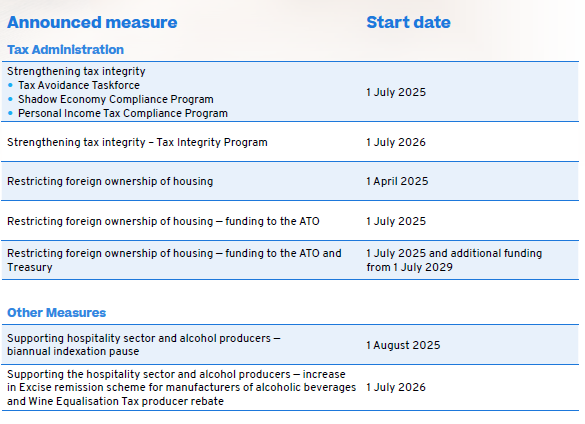
Strengthening tax integrity
The Government will provide $999 million over four years to the ATO to extend and expand tax compliance activities. This additional funding will support the following compliance activities:
- Extension and expansion of the Shadow Economy Compliance Program to reduce shadow economy behaviour such as worker exploitation, under-reporting of taxable income, illicit tobacco and other activity that enables non-compliant businesses to undercut competition.
- Extension and expansion of the Personal Income Tax Compliance Program. This will enable the ATO to continue to deliver a combination of proactive, preventative and corrective activities in key areas of non-compliance.
- Extension of the Tax Integrity Program. This will enable the ATO to continue its engagement program to ensure timely payment of tax and superannuation liabilities by medium and large businesses and wealthy groups.
- A two-year expansion and a one-year extension of the Tax Avoidance Taskforce. This supports continued tax compliance scrutiny of multinationals and other large taxpayers.
Managed investment trusts
The Government will amend the tax laws to clarify arrangements for managed investment trusts. This will ensure legitimate investors can continue to access concessional withholding tax rates in Australia, complementing the ATO’s strengthened guidelines to prevent misuse. This measure will apply to fund payments from 13 March 2025.
The Government will also defer the start date of the 2023–24 Budget measure Extending the clean building managed investment trust withholding tax concession, which will extend eligibility for the concession to data centres and warehouses that meet the relevant energy efficiency standard. The start date of this measure will be deferred from 1 July 2025 to the first 1 January, 1 April, 1 July or 1 October after the applicable Act receives Royal Assent.
Foreign resident capital gains tax regime
The Government will defer the start date of the 2024–25 Budget measure Strengthening the foreign resident capital gains tax regime, which will:
- clarify and broaden the types of assets on which foreign residents are subject to CGT;
- amend the point-in-time principal asset test to a 365-day testing period; and
- require foreign residents disposing of shares and other membership interests exceeding $20 million in value to notify the ATO prior to the transaction being executed.
The start date of this measure will be deferred from 1 July 2025 to the later of 1 October 2025 or the first 1 January, 1 April, 1 July or 1 October after the applicable Act receives Royal Assent.
Non-tax Budget measures of interest
Making student loans fairer
As previously announced by the Prime Minister on 3 November 2024, the Government will reduce all outstanding Higher Education Loan Program (HELP) and other student debts by 20%, subject to the passage of legislation. This measure will wipe $5,520 from an average HELP debt of $27,600 for a university graduate.
The Government is also lifting the minimum income threshold at which HELP debts must be repaid from $54,435 in 2024–25 to $67,000 in 2025–26, and indexing will always stay at 75% of graduate earnings.
The Government is also moving to a marginal repayment system to stop lower-income workers paying a disproportionate share of their salary in debt repayments, as recommended by a major review into tertiary education.
Cost of living – energy rebate
The Government is extending energy bill relief by providing eligible households and small businesses with two $75 rebates directly off their electricity bills until 31 December 2025 to provide cost-of-living relief.
The rebate, which was due to expire at the end of June, will be extended at a cost to the Budget of $1.8 billion.
In his Budget Speech, Treasurer Jim Chalmers said: “Tonight, we’re providing $1.8 billion more energy bill relief. Every household and around one million small businesses will receive energy rebates until the end of 2025. This means cutting another $150 off bills this year.”
The Government said the extension of the energy rebate would take the total power bill relief provided by federal Labor this term to $6.8 billion. While the Government has not kept its pre-election promise to cut power bills by $275, it can point to the provision of substantial cost-of-living support.
The Opposition said it would match the rebate despite having previously labelled it a “band-aid” measure. The rebate will help reduce headline inflation, which the Reserve Bank of Australia was expecting to rise to 3.7% later this year when the first round of rebates expired.
Expansion of the Help to Buy scheme for first home buyers
Under the Help to Buy scheme, the Government will provide an equity contribution of up to 40% to support eligible home buyers to purchase a home with a lower deposit and a smaller mortgage.
The Government will boost the scheme by increasing income caps from $90,000 to $100,000 for individuals and from $120,000 to $160,000 for joint applicants and single parents.
Property price caps will also be increased and linked to the average house price in each state and territory, rather than the dwelling price.
Childcare
In December, the Albanese Government announced a guaranteed three days of subsidised childcare each week, with $1 billion going towards expanding quality and access. The Government promised that if Labor is re-elected, families earning less than $530,000 will qualify for the scheme, which will replace the current activity test model for accessing childcare subsidies.
Legislation for the three-day subsidised childcare guarantee was passed in February.
Prime Minister Anthony Albanese said Commonwealth childcare subsidies would increase by $3.1 billion over four years, supporting an extra 200,000 children to receive early education. The $1 billion fund, rolling out from July 2025, will focus on putting services on school sites where possible and supporting the growth of high-quality not-for-profit providers.
The three-day childcare guarantee will replace the activity test from January 2026 and will cost $427 million over five years. The activity test, which will be scrapped, requires parents to be in paid work or other approved activities to access a childcare subsidy and determines the level of government support based on the number of hours spent doing those activities.
Restricting foreign ownership of housing
The Government will take action to ensure foreign investment in housing supports the Government’s broader agenda to boost Australia’s housing supply in the following ways:
- Banning foreign persons (including temporary residents and foreign-owned companies) from purchasing established dwellings for two years from 1 April 2025, unless an exception applies. Exceptions to the ban will include investments that significantly increase housing supply or support the availability of housing on a commercial scale, and purchases by foreign-owned companies to provide housing for workers in certain circumstances.
- Providing the ATO with $5.7 million over four years from the 2026 income year to enforce the ban.
- Providing the ATO and Treasury with $8.9 million over four years from the 2026 income year, and $1.9 million per year ongoing from the 2030 income year, to implement an audit program and enhance their compliance approach to target land banking by foreign investors.
The enhanced compliance approach by the ATO and Treasury to target land banking will ensure foreign investors comply with requirements to put vacant land to use for residential and commercial developments within reasonable timeframes.
National Anti-Scam Centre
The Government will provide $6.7 million in the 2026 income year to extend the operation of the National Anti-Scam Centre within the Australian Competition and Consumer Commission (ACCC) to continue protecting consumers and businesses from scam activity.
Small business and franchisee support and protection
The Government will provide $12 million over four years from the 2026 income year to support and protect small businesses. The funding will support:
- the ACCC to strengthen regulatory oversight of the Franchising Code of Conduct;
- the Australian Securities and Investments Commission (ASIC) to improve its data analytics capability to better target enforcement activities to deter illegal phoenixing, particularly in the construction sector;
- a partnership with White Box Enterprises to establish a Social Enterprise Loan Fund offering small loans to social enterprises, including work integration social enterprises, to support employment for disadvantaged Australians; and
- Treasury to develop and consult on options to extend protections against unfair trading practices to small businesses, and to protect businesses regulated by the Franchising Code of Conduct from unfair contract terms and unfair trading practices.
Support for the hospitality sector and alcohol producers
The Government will increase support for hospitality venues, brewers, distillers and wine producers through changes to the alcohol tax settings in Australia.
The Government will pause indexation of draught beer excise and excise-equivalent customs duty rates for two years from August 2025. Under this measure, the biannual indexation due in August 2025, February 2026, August 2026 and February 2027 will not occur. Biannual indexation will then recommence from August 2027.
The Government will also increase support available under the existing Excise remission scheme for manufacturers of alcoholic beverages (the Remission scheme) and the Wine Equalisation Tax (WET) producer rebate (the Producer rebate).
Currently, all eligible brewers and distillers can receive an excise remission under the Remission scheme up to a cap of $350,000, and all eligible wine producers can receive a WET rebate up to a cap of $350,000 under the Producer rebate. This measure will increase the caps for all eligible brewers, distillers and wine producers to $400,000 per financial year from 1 July 2026.
Banning non-compete clauses for low- and middle-income workers
The Government will ban non-compete clauses that apply to workers earning less than the high-income threshold in the Fair Work Act (currently $175,000). The Government will also close loopholes in competition law that currently allow businesses to:
- fix wages by making anti-competitive arrangements that cap workers’ pay and conditions, without the knowledge and agreement of affected workers; and
- use “no-poach” agreements to block staff from being hired by competitors.
Superannuation
The Budget includes no significant changes to superannuation. There is $50 million over three years to extend the Tax Integrity Program targeting tax and superannuation liabilities, and $31 million to cover unpaid superannuation to be paid to employees.
Proposed Division 296 regime – uncertainty remains
While no major new super measures were announced in the Budget, the super industry has enough on its plate navigating the uncertainty surrounding the proposed Division 296 regime for superannuation account balances above $3 million from 1 July 2025.
To date, the Australian Labor Party (ALP) has insisted on passing the Division 296 Bills in their current form and has rejected concerns about the taxing of unrealised gains and the $3 million threshold not being indexed. If the ALP is returned to Government at the May election, it is likely that the Bills would be re-introduced, although the proposed 1 July 2025 start date may be delayed.
Super Guarantee: no change to the legislated rise to 12% for 2025–26
The Budget did not announce any change to the timing of the next (and final) Super Guarantee (SG) rate increase. The SG rate is legislated to increase from 11.5% to 12% on 1 July 2025. It has been gradually increasing by 0.5% each year since it was 9.5% in 2020–21. The 12% rate from 1 July 2025 marks its final destination rate.
With the SG rate increasing to 12% for 2025–26 (up from 11.5%), employers need to be mindful that they cannot use an employee’s salary sacrificed contributions to reduce the employer’s extra 0.5% of super guarantee. The ordinary time earnings (OTE) base for super guarantee purposes now specifically includes any sacrificed OTE amounts. This means that contributions made on behalf of an employee under a salary sacrifice arrangement (defined in s 15A of the Superannuation Guarantee (Administration) Act 1992) are not treated as employer contributions that reduce an employer’s charge percentage.
SG opt-out for high-income earners
The increase in the SG rate to 12% from 1 July 2025 also means that the SG opt-out income threshold will decrease to $250,000 from 1 July 2025 (down from $260,870). High-income earners with multiple employers can opt out of the SG regime in respect of an employer to avoid unintentionally breaching the concessional contributions cap ($30,000 for 2024–25 and 2025–26). Therefore, the SG opt-out threshold from 1 July 2025 will be $250,000 ($30,000 divided by 0.12).
Migration
The Budget says net overseas migration will fall from 435,000 in 2023–24 to an estimated 335,000 in 2024–25, 260,000 in 2025–26 and 225,000 in 2026–27. The Budget Papers say: “Net overseas migration (NOM) is declining from its peak in 2022–23 reflecting lower migrant arrivals. NOM is forecast to ease further over the forward estimates. Arrivals are expected to continue to decline in 2024–25 before stabilising in 2025–26. Departures are expected to pick up from recent sustained lows as more people who arrived after the pandemic near the expiry of their visa.”
Additional Treasury resourcing
The Government will provide funding to support the delivery of Government priorities in the Treasury portfolio, including:
- $207 million over two years from the 2026 income year to deliver the second tranche of stabilisation and uplift of ASIC’s business registers, including linking Director Identification Numbers to the Company Register; and
- $0.8 million in the 2026 income year for Treasury to reform Australia’s financial reporting governance arrangements.
Health-related Budget measures of interest
Medicare bulk billing incentives
Ahead of the Budget, the Government announced it would extend the existing Medicare bulk billing incentive to all Australians and create an extra incentive payment for medical practices that bulk bill all their patients.
The Government says the changes would mean an extra 18 million bulk-billed GP visits annually, with nine out of ten GP visits bulk billed by 2030. On the Government’s figures, this would increase the number of fully bulk-billing practices to about 4,800, triple the present figure. The Government says its plan would produce patient savings of up to $859 million a year by 2030.
The health package also promises to boost the number of nurses and doctors in the system. Four hundred nursing scholarships would be provided, and by 2028, 2,000 new GP trainee places would be funded each year in federally funded GP training programs (up from 1,600 in 2025).
The Government has previously tripled the bulk billing incentive for pensioners, concession card holders and families with children. From 1 November, this would be widened to all Australians. Also from 1 November, in addition to the bulk billing incentive, practices that fully bulk bill would receive an extra 12.5% loading on their Medicare rebates.
The Budget provides an additional $8.4 billion over five years from 2024–25 (and $2.5 billion per year ongoing) to increase access to bulk billing, including $7.9 billion over four years to expand eligibility for bulk billing incentives to all Australians and introduce the new Bulk Billing Practice Incentive Program for general practices that bulk bill every visit under Medicare.
PBS patient co-contributions cut
Ahead of the Budget, the Government announced the maximum patient co-contribution for medicines under the Pharmaceutical Benefits Scheme (PBS) will be reduced to $25 a script.
The Government said this is more than a 20% cut in the maximum cost of PBS medicines, which will save Australians over $200 million each year. The last time PBS medicines cost no more than $25 was 2004. Pensioners and concession cardholders will continue to have the cost of their PBS medicines frozen at its current level of $7.70 until 2030.
The Budget Papers said: “The Government will provide $784.6 million over four years from 2025–26 (and $236.4 million per year ongoing) to lower the Pharmaceutical Benefits Scheme (PBS) general patient co‑payment from $31.60 to $25.00 on 1 January 2026.”
Opposition Leader Peter Dutton promised to match Labor’s PBS pledge. The move echoes the 2022 election campaign, when then Prime Minister Scott Morrison pledged to cut the maximum co-payment for PBS medicines from $42.50 to $32.50, and Labor followed with a promise to cut the cost of prescriptions to $30.
50 new Medicare urgent care clinics
Ahead of the Budget, the Government announced it would fund 50 new Medicare urgent care clinics at a cost of $644 million.
The new network of urgent care clinics was central to Labor’s last election campaign, and Labor is now promising to expand the existing 87-clinic network if re-elected, with all 50 new clinics open across every state and territory before the middle of 2026. The clinics offer only bulk-billed consults and operate on a walk-in basis.
$644 million of the $653.8 million program was provisioned for in the 2024–25 MYEFO. Funding includes 50 new clinics, extended hours for three existing clinics and funds to enable state-funded urgent care services to access Medicare items.
Doctors’ groups such as the Australian Medical Association have previously been critical of moves to expand the urgent care clinic network without first fully evaluating its performance.

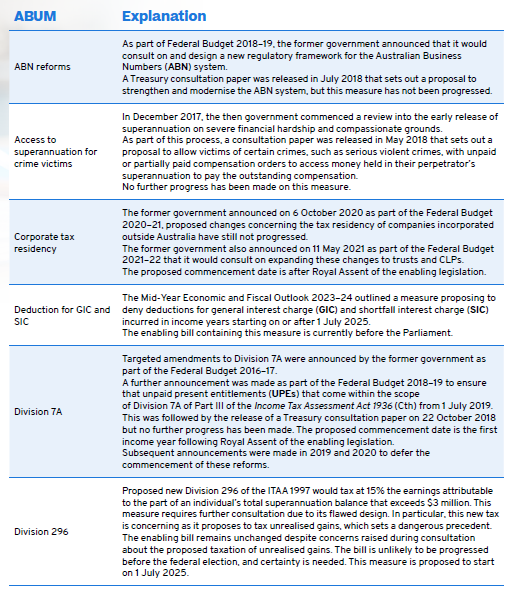
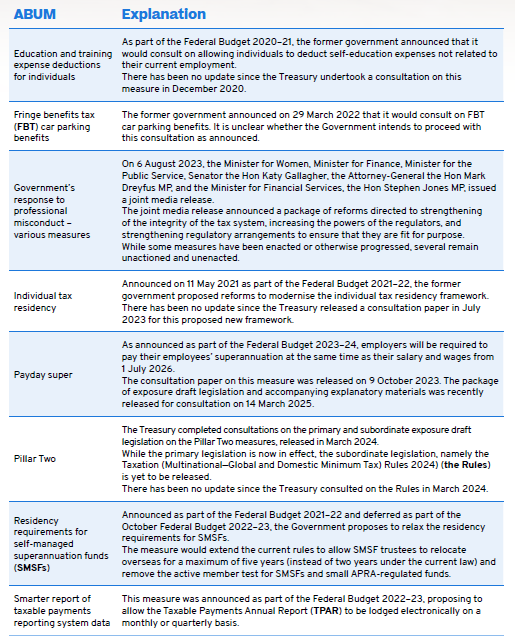
The table below sets out key announced but unenacted measures (ABUMs) that were not addressed in this year’s Budget. The measures are not sorted according to their importance or priority, nor are they an exhaustive list of tax-related ABUMs.

Important information: This article contains general information only and does not take into account your personal objectives, financial situation or needs. It is not a substitute for professional advice, and no responsibility can be accepted for errors, omissions or any action taken as a result of the information it contains. Laws and announced measures may have changed since publication. Please seek advice from a qualified professional relevant to your circumstances before acting. This article has been prepared by our staff using information drawn from various professional publications.
Want to know how the Budget affects you or your business? Contact Mischel & Co or call (03) 9684 9999.